
Beyond Tolerance Analysis: Turning Variation Management into a Competitive Advantage
Key takeaways from Sigmetrix's presentation at the 2026 GENERIS American Automotive Summit at GM's Renaissance Center in Detroit
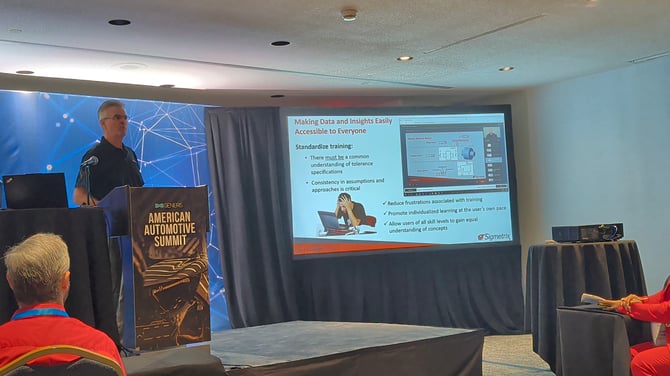
At the 2026 GENERIS American Automotive Summit in Detroit, Sigmetrix shared a perspective that challenges the traditional role of tolerance analysis. Too often, tolerance analysis is treated as a late-stage engineering validation exercise, conducted shortly before production release to confirm that a design will function as intended. While this approach may satisfy immediate requirements, it often leaves significant value on the table. As manufacturers face increasing pressure to accelerate product development, reduce costs, and improve quality, variation management must become a strategic capability that spans the entire product lifecycle.
The presentation explored how mechanical variation affects every manufactured product. No production process is perfect, and every dimension, assembly operation, and operating condition introduces some level of variation. The challenge for engineering organizations is not eliminating variation entirely, but understanding and managing it effectively. Traditional tolerance stack-up analyses, often performed in spreadsheets, can provide useful snapshots of risk, yet they frequently become isolated files that are difficult to access, update, or leverage after the initial design review.
Variation Model - Get More Value for the Work You're Doing
A central theme of the presentation was the concept of the variation model. Rather than viewing tolerance analysis as a one-time calculation, Sigmetrix advocates creating a digital variation model that captures the relationships between dimensions, tolerances, assembly conditions, and system-level requirements. These models can provide engineers with valuable insights, including sensitivity information that identifies how design changes affect product performance and contribution analyses that reveal which dimensions are driving the greatest amount of variation in an assembly.
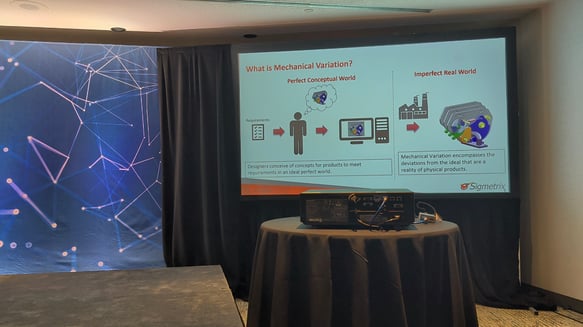
When implemented early in product development, variation management becomes a powerful design optimization tool. Engineers can compare design alternatives, evaluate robustness, and identify opportunities to relax tolerances without sacrificing quality. This enables organizations to select more cost-effective manufacturing processes while maintaining confidence that critical product requirements will be achieved. By understanding variation before physical prototypes are built, companies can identify and resolve issues virtually, avoiding expensive late-stage redesigns and production disruptions.
The presentation also highlighted how variation models can support functions beyond engineering. Manufacturing teams can use contribution data to focus inspection resources on characteristics that truly impact product performance. Quality teams can correlate inspection results with simulation data to improve process control. Supply chain organizations can evaluate the impact of supplier variation and make more informed decisions when nonconforming parts are discovered. In each case, the variation model serves as a bridge connecting design intent with operational decision-making.
GD&T - Standardize Communication Throughout the Digital Thread
Another important topic was the growing role of Model-Based Definition (MBD) and Geometric Dimensioning and Tolerancing (GD&T). As organizations continue their digital transformation initiatives, they are generating increasing amounts of product data throughout the digital thread. The presentation emphasized that GD&T provides the unambiguous language required to communicate permissible variation between systems, suppliers, and manufacturing operations. As digital workflows become more automated, clear and standardized methods for defining variation become increasingly critical.
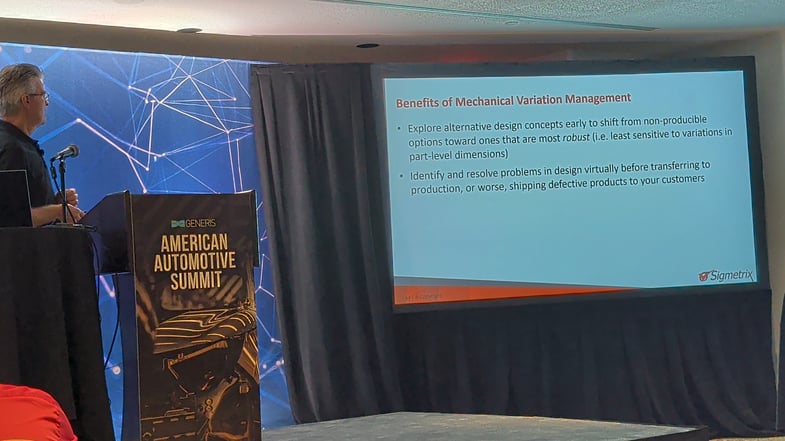
Ultimately, the message was clear: variation management should not be viewed as a final quality check. It should be considered a strategic asset that informs design decisions, improves manufacturing efficiency, enhances communication across the enterprise, and supports profitability throughout the product lifecycle. Organizations that successfully integrate variation models into their digital thread will be better positioned to develop robust products, accelerate innovation, and maximize the return on their MBD investments.
How to Create a Variation Model?