
How MBD Helps Reduce Engineering Documentation Errors
Key Takeaways
- Model-Based Definition (MBD) turns 3D models into the authoritative source of product and manufacturing information (PMI), ensuring that design intent, tolerances, and annotations are communicated clearly across all stages of production.
- With integrated PMI, teams achieve greater consistency and minimize errors from outdated or conflicting documents.
- Adopting MBD supports faster, more accurate workflows while improving first-pass yield and document traceability.
Traditional 2D engineering documentation leaves room for costly mistakes, including misinterpretation, version control problems, and errors from manual data transfer. Model-Based Definition (MBD) offers a smarter solution.
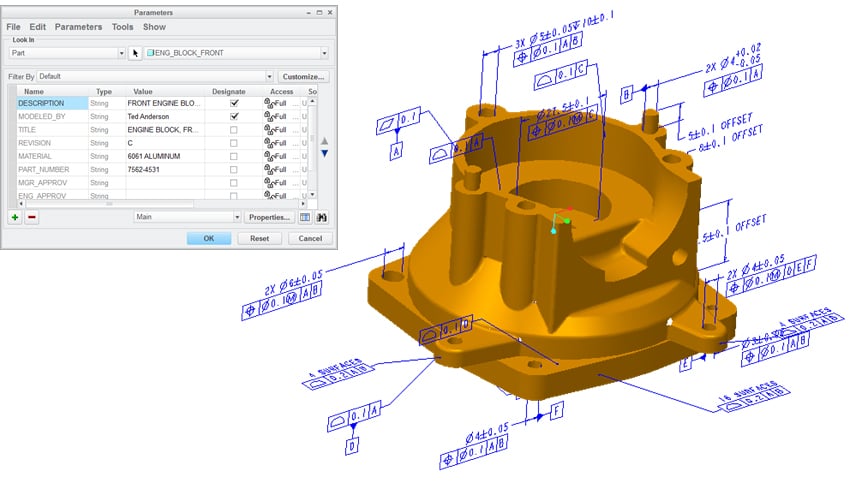
By embedding product and manufacturing information (PMI) directly into CAD models, MBD unites design and documentation in a single digital source of truth. Here’s how MBD streamlines workflows and reduces the risk of engineering documentation errors.
The Documentation Challenges of Traditional 2D Workflows
Traditional 2D documentation methods involve several points of risk that slow processes and introduce costly errors, including:
- Translating 3D models into 2D drawings often leads to inconsistencies between the design and documentation.
- Multiple drawing versions may circulate across departments, creating confusion and increasing the chance of accidentally working from outdated information.
- Missing, unclear, or misinterpreted annotations cause communication breakdowns between design, manufacturing, and inspection teams.
- Transferring tolerance, material, or inspection data manually into spreadsheets or downstream systems increases error rates.
These issues make it difficult to maintain documentation integrity throughout the product lifecycle.
4 Ways MBD Improves Documentation Accuracy
Model-Based Definition solves many of the problems of traditional 2D workflows by providing a more reliable and efficient way to communicate product requirements.
Single Source of Truth: MBD embeds all product manufacturing information (PMI) directly into the 3D CAD model. This eliminates the need for separate 2D drawings or external documents to communicate critical details. Everyone, from design to inspection, works from the same authoritative model and the same set of tolerances, material specs, and annotations.
Automatic Updates: With MBD, modifying the 3D model automatically updates all linked PMI, including GD&T annotations, notes, and material callouts — as long as the PMI is semantically linked to the model. Automatic updates prevent the common error of forgetting to revise accompanying documentation after modifying a design. The result is more accurate product data and a more reliable digital thread.
Efficient Data Transfer: Traditional workflows often require engineers or inspectors to retype dimensions, tolerances, or material specifications into spreadsheets, inspection reports, or CAM systems. MBD eliminates these repetitive manual tasks because downstream systems can read PMI directly from the model. This reduces transcription errors and speeds up handoffs between teams.
Alignment Across Teams: MBD promotes better alignment between design, manufacturing, quality, and supplier teams. Working from the same annotated 3D model minimizes confusion, reduces costly mistakes, and streamlines collaboration.
Benefits of MBD for Engineering Documentation
Model-Based Definition offers significant advantages for engineering documentation, including:
- Reducing rework and costly delays caused by outdated or conflicting drawing sets.
- Improving first-pass yield by clearly communicating design intent and reducing ambiguity.
- Streamlining design reviews by eliminating the need to cross-reference multiple documents.
- Enhancing audit readiness by maintaining traceable, revision-controlled documentation that simplifies compliance reporting.
- Simplifies alignment with GD&T standards like ASME Y14.5 or ISO GPS, supporting consistency across global operations.
These benefits aren’t just theoretical. Many manufacturers are already using MBD to reduce documentation errors and improve overall quality.
Real-World Scenarios Where MBD Reduces Errors
Scenario 1: Manufacturing Misreads a Drawing Note
Without MBD: Manufacturers rely on 2D drawings that may contain unclear or incomplete notes. This increases the risk of misinterpretation and costly production errors.
With MBD: PMI is embedded directly into the 3D model. Machinists and assemblers can see the design intent clearly from every angle, reducing ambiguity.
Scenario 2: An Engineer Updates the CAD Model but Forgets to Revise the Drawing
Without MBD: Updates to the 3D model don’t always make it to the 2D drawings. This disconnect often results in parts made to outdated specifications.
With MBD: Updates to the model automatically include updated PMI, so the model and documentation stay inherently aligned.
Scenario 3: Supplier Receives an Outdated Drawing Version
Without MBD: Suppliers may work from older drawings, causing quality issues or rework.
With MBD: Suppliers receive a single, revision-controlled 3D file with embedded PMI, ensuring they work from the correct data.
Tools That Support MBD-Based Documentation Workflows
To successfully implement MBD-based workflows, teams need the right mix of tools. This table highlights key categories of MBD-enabling technologies that support digital documentation, data integrity, and seamless collaboration:
|
Category |
Examples |
How They Support MBD |
|
CAD Platforms with MBD Functionality |
PTC Creo, CATIA, Siemens NX, SolidWorks |
Allow users to embed PMI directly into 3D models, creating a single source of truth. |
|
Standard File Formats for PMI |
STEP AP242, JT, QIF |
Enable sharing of 3D models with embedded PMI across different systems and suppliers, preserving data integrity. |
|
Tolerance Analysis/GD&T Tools |
Sigmetrix CETOL 6σ, GD&T Advisor |
Integrate tolerance stack-up analysis and GD&T validation into MBD workflows, ensuring accurate design intent. |
|
PLM Systems for Version Control |
Windchill, Teamcenter, Solidworks PLM, 3DEXPERIENCE (Enovia) |
Manage revision-controlled MBD files and maintain the digital thread across design, manufacturing, and QA. |
Best Practices for Transitioning to MBD
Successfully adopting Model-Based Definition requires a thoughtful, phased approach:
- Identify High-Risk Processes: Start by pinpointing documentation-heavy workflows where errors, rework, or misinterpretation frequently occur. These areas will benefit most from MBD.
- Train Your Teams: Ensure engineers, machinists, inspectors, and suppliers know how to read and apply 3D PMI. Comprehensive training reduces confusion and builds confidence in the new workflow.
- Start with Pilot Projects: Instead of overhauling everything at once, apply MBD to select parts or assemblies. Use these pilots to refine your approach before expanding.
- Align with Digital Transformation Goals: Position MBD as part of a broader move toward a Model-Based Enterprise (MBE). Consider how your efforts support long-term innovation and efficiency.
Achieving Clarity and Accuracy with MBD
By turning the 3D product model into the single source of truth for product definition, Model-Based Definition (MBD) dramatically reduces documentation errors. When teams work from a shared, annotated model, they make fewer mistakes and improve documentation integrity. Companies that embrace MBD are better equipped to meet today’s demands for quality, precision, and speed.
Want to improve accuracy and reduce engineering errors across your organization? Explore Sigmetrix’s MBD-ready tools and consulting services to help you build a stronger, smarter documentation process.