
How Model-Based Definition Supports Industry 4.0 Initiatives
Key Takeaways
- MBD embeds product and manufacturing information (PMI) directly within the 3D model, creating a single source of truth that supports connected manufacturing workflows.
- Structured, machine-readable PMI enables automation in CAM programming, inspection planning, and closed-loop manufacturing systems.
- Organizations that address skills gaps, software interoperability, and supplier readiness are best positioned to realize the full value of MBD.
As manufacturing becomes more connected and automated, the ability to move clean, accurate data across functions has never been more important. Industry 4.0 demands seamless communication between design, engineering, and production systems, but traditional drawing-based workflows struggle to keep pace.
Model-based definition (MBD) addresses this communication gap directly by including all product and manufacturing information within the 3D model itself. When downstream systems can access accurate, authoritative data without manual re-entry or interpretation, manufacturers unlock faster production cycles, fewer errors, and tighter integration across the digital thread.
In short, MBD allows organizations to lay the foundation for a truly connected factory.
What Is Model-Based Definition?
Model-based definition is an approach to product development in which the 3D CAD model serves as the sole authoritative source of product and manufacturing information.
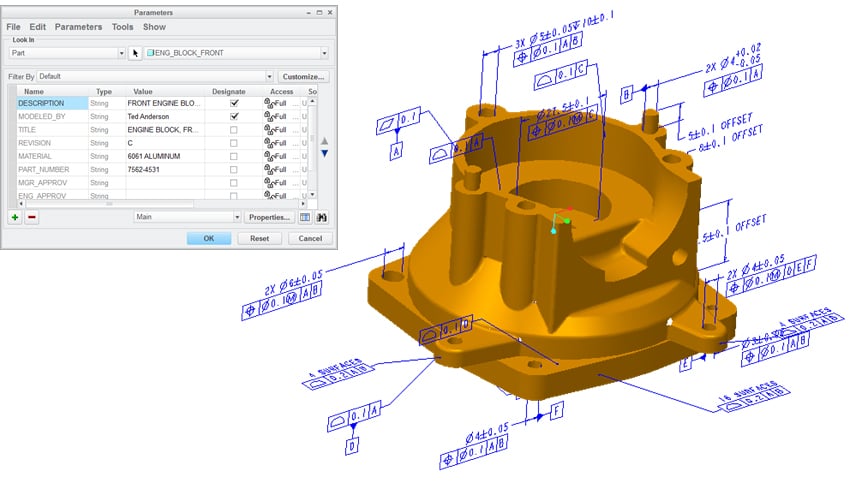
Instead of generating 2D engineering drawings to communicate specifications, MBD embeds product manufacturing information (PMI) directly within the 3D model. This includes GD&T annotations, tolerances, surface finish requirements, material callouts, and any other data necessary to fully define the part or assembly.
MBD shifts manufacturers away from drawing-based workflows, where information must be manually interpreted and re-entered at each handoff, toward model-based workflows that allow downstream systems to consume data directly and reliably.
Standards like ASME Y14.41 provide the framework governing how this information is structured and presented, ensuring consistency and interoperability across teams, suppliers, and manufacturing systems. The goal of MBD is to create a single, intelligent dataset that travels with the model as it moves through production.
Understanding Industry 4.0 and the Digital Manufacturing Landscape
MBD is just one example of the broader shift toward digitization that is reshaping modern manufacturing. Industry 4.0 refers to the ongoing integration of real-time data exchange and intelligent automation across the production environment. This shift is characterized by the technologies involved: digital twins, smart factories, automated inspection, and connected production systems.
These technologies all share a common dependency on reliable, structured data. This is where MBD becomes foundational:
- Digital twins require accurate product definitions to simulate real-world behavior.
- Automated machining and inspection systems need machine-readable PMI to execute without human intervention.
- Connected supply chain systems depend on consistent, interoperable data to coordinate seamlessly across suppliers, manufacturers, and partners.
For these technologies to function effectively, engineering, production, and inspection teams and systems must speak the same language. MBD provides exactly that common data foundation.
The Role of MBD
MBD plays a central role in establishing and maintaining the digital thread — the connected flow of data that links every stage of the product lifecycle. Here’s how:
A Single Source of Truth: By embedding all product and manufacturing information directly in the 3D model, MBD ensures that every downstream system works from the same authoritative dataset, eliminating the inconsistencies that arise when teams maintain separate drawings and documentation.
Data Continuity Across the Lifecycle: MBD preserves data integrity from design through production and quality inspection. Where 2D drawing-based workflows introduce information loss at each handoff, MBD keeps the data intact and traceable.
Improved Traceability: Because all specifications are tied directly to the model, manufacturers can trace every decision and requirement back to its source, supporting compliance, auditing, and continuous improvement efforts.
How MBD Enables Automation in Smart Manufacturing
MBD is designed to deliver structured, machine-readable data directly within the 3D model, but it only works when designers apply PMI intentionally and correctly. When done well, this reduces the manual interpretation steps that slow down production and introduce errors.
Here are four key ways well-executed MBD supports automation at each stage of production:
- Automated CAM Programming: CAM software can extract machining parameters directly from PMI-enabled models, reducing the time and risk associated with manual programming and setup.
- Inspection Planning and Automated Measurement: CMMs and other metrology systems can consume GD&T data directly from the model to generate inspection routines automatically, eliminating the need to manually interpret 2D drawings.
- Reduced Setup Interpretation: With MBD, operators and automated systems receive unambiguous instructions that minimize the risk of misinterpretation during manufacturing setup.
- Closed-Loop Manufacturing: When inspection systems feed measurement data back into the production environment, manufacturers can adjust processes in real time, creating a feedback loop that depends on the structured data MBD provides.
Benefits of MBD for Industry 4.0 Initiatives
Automation gains are just one part of MBD’s larger value proposition. When paired with a Product Lifecycle Management (PLM) system, MBD improves communication between design, manufacturing, and quality teams by ensuring everyone works from the same centralized, up-to-date model.
When engineering changes are required, updates propagate from a single source, reducing turnaround time and the risk of teams working from outdated information. Eliminating inconsistencies in documentation also reduces downstream errors that are costly to catch and correct late in production.
Beyond day-to-day operations, MBD strengthens an organization’s readiness for digital twin and simulation technologies by providing the foundation necessary for advanced analytics and process optimization initiatives. Realizing these benefits, however, is not without its challenges.
Challenges Organizations Face When Implementing MBD — and How to Overcome Them
Adopting MBD as part of an Industry 4.0 strategy delivers significant long-term value, but the transition is not without obstacles. Organizations that anticipate these challenges and address them proactively are better positioned to realize the full benefits of model-based workflows.
Resistance to Change
The Challenge: Teams accustomed to drawing-based workflows may be reluctant to abandon familiar processes, particularly when existing methods feel reliable.
The Solution: Start with pilot programs that target a specific product line or process. This helps you demonstrate measurable improvements in speed and accuracy, building the internal momentum needed to drive broader adoption.
Skills Gaps
The Challenge: Applying GD&T and PMI effectively within 3D CAD models requires a level of expertise that many teams have not yet developed.
The Solution: Role-specific training programs ensure that every team member can interpret and contribute to model-based workflows with confidence. Training should be tailored to the needs of designers, manufacturing engineers, quality personnel, and any other stakeholders who interact with model-based data.
Software Interoperability
The Challenge: Inconsistent tool support can fragment the data continuity that MBD is intended to provide.
The Solution: To minimize the risk of data loss or misinterpretation as data moves between systems, organizations should standardize on CAD and PLM platforms that natively support PMI and model-based data exchange.
Supplier Readiness
The Challenge: Transitioning to model-based data exchange extends beyond internal teams. Suppliers must also be equipped to receive, interpret, and act on model-based datasets.
The Solution: Early engagement, clear data exchange standards, and collaborative onboarding help bring supply chain partners into alignment before gaps become costly.
With the right preparation, these challenges are manageable. Organizations that navigate them successfully position MBD as a strategic enabler of their broader Industry 4.0 ambitions.
MBD Lays the Foundation for Industry 4.0
Model-based definition is a strategic investment in the data infrastructure that Industry 4.0 demands. With MBD, organizations can improve communication, accelerate automation, and build the modern, connected workflows they need to keep a competitive edge as manufacturing continues to evolve.
Ready to explore how MBD can support your Industry 4.0 initiatives? Explore our training and consulting services. Our team is ready to help you build the skills and systems needed to make model-based workflows a reality in your organization.