
Why MBD is Essential for the Aerospace and Automotive Industries
Key Takeaways
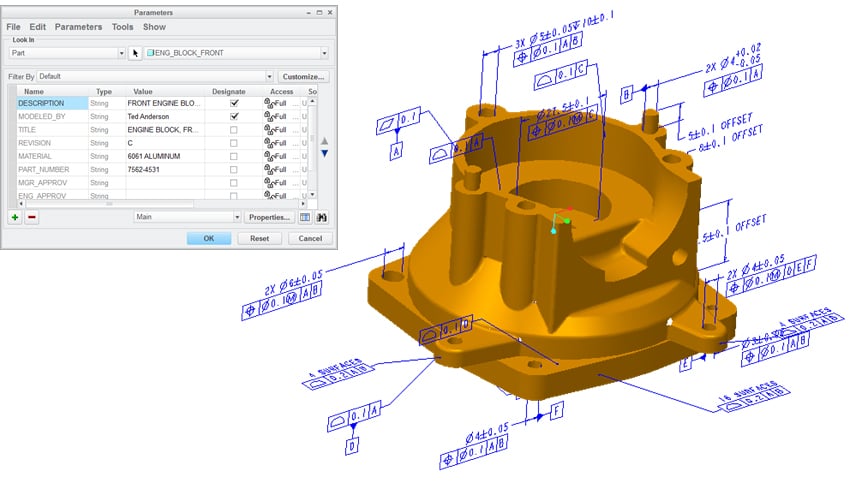
- MBD embeds GD&T and PMI directly into 3D CAD models, replacing traditional annotated 2D drawings.
- MBD boosts accuracy, compliance, and collaboration in aerospace and automotive manufacturing. It also speeds development cycles, improves first-pass yield, and supports digital twin initiatives.
- Becoming a Model-Based Enterprise (MBE) requires cultural change, supplier compatibility, and toolchain alignment.
The automotive and aerospace industries are demanding engineering environments where safety, performance, and compliance leave no room for error. Traditional 2D drawing workflows simply can’t keep pace with the complexity, precision, and traceability required in these sectors.
Model-Based Definition (MBD) offers a more powerful and reliable alternative for aerospace and automotive manufacturers. MBD drives tighter design integration and clearer communication across the supply chain, ensuring complex systems meet rigorous regulatory and operational standards.
The Demands of Aerospace and Automotive Engineering
Aerospace and automotive manufacturing demands precision at every stage. Requirements in these sectors often push the limits of design and production capabilities.
Performance Under Extreme Conditions: Aerospace and automotive components must operate flawlessly in harsh environments, enduring extreme temperatures, intense vibration, high speeds, and significant pressure. These factors place exceptional demands on design accuracy and durability.
Complex, Interconnected Systems: From aircraft propulsion systems to automotive powertrains, automotive and aerospace assemblies are tightly integrated, with many crucial features and components. Even a small dimensional error in one area can cascade into system-wide performance or safety issues.
Compliance with Rigorous Standards: Both industries are governed by strict quality frameworks, such as AS9100 for aerospace and IATF 16949 for automotive. These standards require precise documentation, full traceability, and consistent manufacturing results.
Pressure for Rapid Delivery Without Compromising Quality: Manufacturers face intense competition to accelerate design cycles and bring products to market faster while still meeting exacting dimensional and functional requirements. MBD helps automotive and aerospace manufacturers meet these demands by increasing precision, efficiency, and traceability throughout production.
What Is Model-Based Definition (MBD)?
Model-Based Definition is a modern approach to product definition that replaces traditional 2D engineering drawings with fully annotated 3D CAD models. In an MBD workflow, crucial information regarding Geometric Dimensioning & Tolerancing (GD&T), materials, surface finishes, and other Product Manufacturing Information (PMI) is embedded directly into the model.
This approach creates a single, authoritative source of truth that design, engineering, manufacturing, quality, and inspection teams can all work from. MBD also forms the foundation of the digital thread and enables seamless data flow into CAM, CMM, PLM, and other downstream systems.
As part of a larger Model-Based Enterprise (MBE) strategy, MBD supports greater efficiency and collaboration across the entire product lifecycle.
Why MBD Is a Game-Changer for Aerospace
In aerospace engineering, safety and compliance requirements are stringent. Using MBD in aerospace design and manufacturing delivers measurable gains in accuracy, speed, and lifecycle efficiency.
Reducing Documentation Errors: In aerospace programs, even a minor documentation error can lead to costly delays and safety risks. MBD embeds GD&T, material specs, and other PMI directly into the 3D model, ensuring all stakeholders are working from the same, up-to-date source.
Enhancing Traceability and Compliance: Regulatory frameworks like AS9100 demand precise record-keeping and verifiable processes. MBD supports full traceability by linking every feature and tolerance to the model. This traceability streamlines audits and minimizes errors.
Accelerating Reviews and Supplier Onboarding: With fully annotated 3D models, design reviews are faster and more interactive. Instead of working from a patchwork of drawings and revision notes, suppliers receive a single, authoritative model that contains all necessary information. They can qualify parts directly from the model, expediting onboarding and reducing delays caused by missing documentation.
Powering Digital Twins and Simulation: MBD creates richer datasets for simulation-driven design and digital twin programs, helping predict performance and maintenance needs long before production begins.
By streamlining collaboration, improving compliance, and reducing costly errors, MBD in aerospace is becoming a cornerstone of the industry.
Why MBD Matters in the Automotive Industry
Automotive manufacturing is defined by high production volumes, tight deadlines, and the need for precise, repeatable quality across global supply chains. MBD offers the tools and processes to meet these demands.
Faster Iteration During Development: By embedding PMI directly into the 3D CAD model, MBD enables engineers to make quick design changes without working about outdated 2D drawings. This approach speeds up the process of refining individual components and complete assemblies during vehicle development.
Stronger OEM-Supplier Alignment: A single, annotated 3D model ensures that OEMs and suppliers work from the same specifications and tolerances, minimizing costly misunderstandings and rework.
Enabling Digital Manufacturing & Quality Assurance: MBD supports automated manufacturing and inspection processes, ensuring consistent quality in high-volume automotive environments.
Seamless Global Collaboration: With universally accessible 3D models, teams across regions can collaborate effectively on shared vehicle platforms.
MBD in automotive manufacturing streamlines product development, strengthens supplier relationships, and drives precision at every stage of production.
Key Benefits of MBD Across Both Industries
In both aerospace and automotive engineering, speed, precision, and accuracy are non-negotiable. Model-Based Definition delivers tangible benefits, including:
- Shorter Design-to-Production Cycles: With product data embedded in the model, teams minimize redundant documentation handoffs and accelerate release timelines.
- Better First-Pass Yield: Clear, model-based annotations remove ambiguity, reducing rework and scrap caused by misinterpretation.
- Support for Downstream Automation: CAM, CMM, additive manufacturing, and SPC systems can consume PMI directly from models, minimizing manual data entry.
- Reduced Risk of Version Mismatches: A single, managed CAD file ensures everyone works from the latest approved data, avoiding costly engineering change errors.
Ultimately, MBD in aerospace and automotive manufacturing supports a faster, more reliable path from concept to production.
Overcoming Barriers to MBD Adoption
While the benefits of MBD are clear, successful adoption requires addressing both technical and cultural challenges. Shifting from 2D drawings to fully annotated 3D models changes long-standing habits, and leaders may face some internal resistance from their own teams. Clearly communicate the benefits of MBD — speed, accuracy, and reduced rework — to improve buy-in.
Most organizations move through a phased transition that makes the process more manageable:
- Drawings only — the traditional baseline, no model-based data
- Drawings master, model supplementing — drawings remain authoritative, but 3D models being providing additional context
- Model master, drawings supplementing — the model becomes the source of truth, with drawings retained for compatibility or supplier needs
- Model only — fully realized MBD, with no reliance on 2D drawings
Many companies operate successfully in a hybrid format. As long as stakeholders understand which deliverable serves as the authoritative source of truth, hybrid approaches can be highly effective.
Training for 3D PMI also helps. Provide engineers, machinists, and inspectors with tailored MBD training to ensure they can read, interpret, and apply Product Manufacturing Information accurately.
But even if your team is MBD-ready, your suppliers may not be. Work with suppliers to assess their digital capabilities, provide training or viewer tools as needed, and establish standard formats like STEP 242 to make data exchange smoother across the supply chain.
Finally, address toolchain alignment. MBD must integrate seamlessly with CAD platforms, PLM systems, and inspection tools to maintain a continuous digital thread. A well-aligned toolchain prevents data loss, eliminates redundant file formats, and supports real-time collaboration between design, manufacturing, and quality teams.
By proactively addressing these barriers, organizations can unlock the full value of MBD while minimizing rollout friction.
Embracing MBD in Aerospace and Automotive
Model-Based Definition is now a cornerstone of precision, efficiency, and digital transformation in aerospace and automotive manufacturing. By closing documentation gaps, reducing costly errors, and enabling seamless collaboration across the product lifecycle, MBD empowers teams to deliver safer, higher-quality products at speed.
Want to bring MBD into your workflow? Talk to Sigmetrix about tools, training, and consulting that help your team lead with precision and speed.